This guide explains how a Talkdesk Chatbot supports faster, more consistent customer service through intelligent conversation flows and workflow automation. Objectively, “Talkdesk Chatbot” refers to an AI-assisted customer support channel integrated with contact-center systems. We review core capabilities, practical implementation choices, and decision conditions so teams can evaluate fit for their support operations.
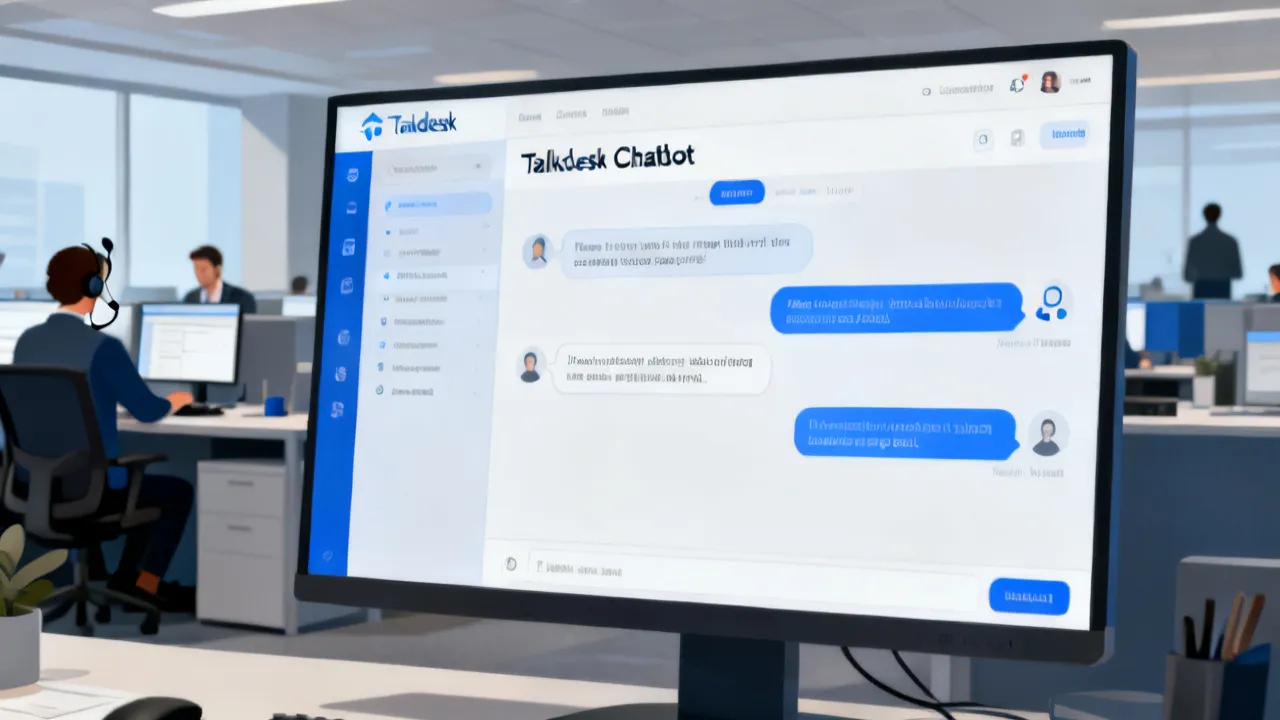
A Talkdesk Chatbot typically creates the quickest operational impact by reducing avoidable agent workload and improving response consistency for common intents (order status, appointment requests, account questions, and policy explanations). In very contact-center environments, its effectiveness depends less on “having a bot” and more on how well conversation design is aligned with your knowledge base, routing rules, and escalation paths. From an industry perspective, the very reliable outcomes come when the bot handles clear, well-scoped tasks and hands off seamlessly when uncertainty increases.
That is why early success usually shows up in the metrics that contact centers track daily: fewer repetitive interactions for agents, faster first-response times for customers, improved resolution consistency, and lower operational friction when cases require specialized support. The fastest way to reach those outcomes is to treat the chatbot as an integrated service workflow—not as a standalone “assistant” that only answers questions. The value emerges when the bot can: (1) recognize intent, (2) collect the exact details needed to complete a request, (3) consult trusted internal sources, and (4) take the next action (or escalate with context) in a way that matches your customer service operating model.
In practice, the value is greatest when the bot’s capabilities are deliberately shaped around your highest-volume and most predictable contact reasons. When you prioritize the right intent categories and design escalation rules that protect customers from inaccurate or incomplete outcomes, your chatbot becomes an operational multiplier: it absorbs the routine load and routes higher-complexity work to human experts efficiently.
In objective terms, the phrase Talkdesk Chatbot generally denotes an AI-driven conversational interface used in customer support. It interacts with end users through web chat or messaging surfaces and can be connected to broader contact-center workflows—such as ticket creation, agent routing, and knowledge retrieval. The practical goal is straightforward: answer questions faster, guide customers to the right next step, and reduce repetitive manual work.
Unlike a static FAQ page, a chatbot can interpret user intent, request missing details, and produce context-aware responses. It can follow a structured dialogue, confirm the user’s identity (where required), and then deliver results grounded in internal systems. However, it still depends on the quality of the underlying content and integration design. In other words, a chatbot is only as effective as the “system of record” it consults (product catalogs, order databases, policy documents, account data) and the guardrails that define when it should escalate to a human.
In a well-implemented environment, a Talkdesk Chatbot is not merely “answering.” It can act as a front line for service orchestration: it can check order status, initiate a return workflow, gather information for appointment scheduling, explain policy steps, or guide a customer through identity verification or account recovery. Even when the bot does not directly execute every downstream process, it can prepare the conversation output so that agents begin with already-collected details rather than repeating questions from the start.
It’s also important to distinguish between conversational surfaces and operational capabilities. A bot that only provides text responses may still reduce workload marginally, but its value is often capped if it cannot complete workflows or create structured tickets. On the other hand, a bot that can trigger actions and follow defined states can reduce handling time and improve first-contact resolution, particularly for customers whose intent falls within the bot’s supported task scope.
When teams assess a Talkdesk Chatbot for deployment, the evaluation should focus on capabilities that influence containment rate, customer satisfaction, and operational control. Below are the very important features to consider.
In many organizations, the very successful early chatbot deployments target “high-frequency, low-to-medium complexity” requests. For example:
These use cases share a property: the correct answer is either available in a reliable source or can be determined through a short sequence of clarifying questions. As the request complexity rises, the chatbot’s value depends on escalation design and integration depth. In other words, a bot doesn’t have to handle every possible issue to deliver major ROI. If it handles only the portion of contacts that are routine, predictable, and safe—while escalating effectively for everything else—agents can focus on the interactions that need human expertise.
In many contact centers, there’s also an important operational nuance: “complexity” isn’t only about the customer’s request; it’s also about the number of systems and handoffs required to resolve it. A chatbot that can query order management directly and produce a delivery estimate can solve a problem quickly. But if resolution requires multiple back-office approvals, fraud checks, or specialized ticket routing, the bot may only prepare information and escalate. That still improves operational efficiency when done correctly.
Another reason targeted scenarios succeed is that they lend themselves to robust conversation patterns. When you can define the minimal set of fields needed for resolution—like order number, email, service type, or preferred time window—you can design the dialogue to collect those fields reliably. The bot then becomes consistent and predictable, which is what customers experience as “good service.”
Customer expectations in modern service environments tend to favor speed and clarity. Major industry research consistently indicates that self-service and fast resolution contribute to perceived service quality. For instance, Gartner has repeatedly discussed the strategic importance of customer experience and service automation, emphasizing measured improvements rather than “technology for technology’s sake.” (For source context, see Gartner’s published research summaries on customer service transformation and conversational AI strategy.)
Similarly, contact-center industry groups such as the International Customer Management Institute and industry analysts have documented how automation and digital channels reshape expectations for response times and consistent service delivery. While exact numbers vary by segment and maturity level, the direction of travel is consistent: organizations are investing in conversational interfaces to reduce wait times and standardize responses.
Because you asked for a professional, objective approach, it’s important to treat performance claims cautiously. Any “typical” containment rate or savings estimate should be validated against your own intent mix, knowledge quality, and integration design. If a vendor provides benchmarks, those should be compared to your environment using pilot results rather than assumed adoption outcomes.
It’s also worth considering how measurement culture affects outcomes. Many programs underperform not because the technology is incapable, but because measurement is weak. Without clear baselines and consistent QA standards, teams can’t distinguish between “the bot improved outcomes” and “the bot was deployed with insufficient intent scope and then blamed for business complexity.” Strong governance and consistent evaluation processes are what make measurable improvements repeatable.
In practice, measured outcomes often look like this:
When these outcomes are tracked at both the conversation level and the business process level (tickets resolved, appointments scheduled, documents updated), the chatbot program becomes a measurable capability rather than an experimental channel.
A Talkdesk Chatbot implementation should be treated like a product launch inside the contact center—complete with governance, measurement, and iterative improvement. Below is an expert-style way to plan the work so the project stays aligned with customer needs and support operations.
Start with an intent inventory drawn from historical contacts: tickets, chat transcripts, call drivers, and web queries. Then prioritize by impact and feasibility. The goal is to choose intents where:
Define success metrics early. For example:
In addition to common KPIs, define operational targets such as:
Success should also be framed in customer terms. A chatbot may “contain” a request but still deliver a poor customer experience if it delays resolution or provides irrelevant guidance. Therefore, success metrics should include both quantitative and qualitative signals: satisfaction ratings, agent feedback, and QA review outcomes.
Chatbots should speak in a consistent tone and follow policy. Ensure your bot’s responses are grounded in approved documentation. For regulated industries (health, finance, telecom, utilities), compliance is not optional. Define what the bot can and cannot say, including disclaimers where required.
Alignment involves more than copying policy documents into a knowledge base. You need to translate formal policy language into customer-readable guidance and structure it in a way that supports conversation flows. In a practical implementation, teams often create a “conversation-ready” knowledge layer that includes:
Tone and brand voice also matter operationally. Customers interpret the bot’s tone as professionalism or indifference. If the bot is overly technical, it can increase repeat questions. If it is too casual for a regulated environment, it can create trust issues. A well-designed bot uses consistent language patterns, acknowledges uncertainty appropriately, and avoids unnecessary jargon.
Compliance requirements should also influence escalation logic. For example, certain topics may require human review even if an answer seems “available.” In regulated settings, the bot may provide general information but must escalate for specific cases involving eligibility exceptions, financial determinations, or personally sensitive data.
Escalation logic is a decisive factor in whether customers accept a bot. Build clear triggers such as:
When escalation occurs, customers should not start from scratch. The handoff should include relevant conversation context (intent, collected fields, summary) so the agent can proceed efficiently.
To make escalation feel seamless, define a “handoff contract” between bot and agent. This contract includes:
Escalation is also where customer experience can be won or lost. If the bot escalates with minimal context, the agent must ask the same questions again. That increases handling time, frustrates customers, and can lead to negative customer satisfaction signals. A high-performing chatbot program invests in escalation usability for agents, not only in customer-facing dialogue.
Another important detail is channel parity. If the chatbot operates in web chat but your human support channel is phone, you must determine the best handoff method. Some teams implement a “transfer to agent” model where chat continues and the agent joins the conversation. Others instead create a ticket and notify an agent or send a callback request. The escalation design should match your contact center’s workflow reality.
Many teams make the mistake of using a chatbot only to “respond.” For business value, connect it to actionable workflows: create or update tickets, initiate a service request, guide customers through self-service steps, or trigger a status inquiry. This transforms a chatbot from a conversational novelty into an operational tool.
Workflow-enabled capabilities tend to produce strong ROI because they remove manual steps from the service process. For example, instead of telling a customer “We’ll email you when your document is ready,” the bot can check the document status in your system and provide the current stage. Similarly, for scheduling, a bot can query available slots and request confirmation, rather than giving generic instructions to fill out a form.
When you connect the bot to workflows, ensure that you define the workflow states clearly. Each action should produce a deterministic outcome that the bot can interpret. A common failure mode is when the bot triggers a workflow but cannot accurately confirm completion, leaving the customer uncertain. To avoid this, validate end-to-end integration and define how the bot updates the conversation based on workflow status.
Workflow integration also requires field mapping. If your ticketing system requires structured categories (billing, technical support, account access) and specific identifiers (customer ID, product line, region), your bot must capture those fields reliably. The bot should confirm critical fields and validate formats (for example, order numbers) to reduce downstream errors.
A Talkdesk Chatbot should improve over time. Establish:
Continuous improvement requires disciplined processes and ownership. For instance, you may create a cross-functional review group that includes customer support leadership, knowledge management owners, compliance stakeholders, and contact center QA analysts. This group should review:
It’s also useful to implement a “conversation QA” methodology. Instead of relying only on model metrics or aggregate intent accuracy, evaluate conversations manually or semi-manually using a structured rubric. Over time, you can correlate rubric outcomes with operational KPIs to identify what “good” looks like for your business.
You did not provide explicit numeric price, supplier names, or a specific city/country in the prompt. In real procurement, however, the cost model for a Talkdesk Chatbot implementation often depends on:
Supplier selection typically matters for two reasons: (1) the supplier’s ability to integrate with your environment and (2) the supplier’s maturity in conversational analytics and ongoing optimization. When comparing suppliers, ensure you understand what’s included—conversation design support, knowledge onboarding, analytics dashboards, and lifecycle management.
In procurement discussions, it’s easy to focus on “per conversation pricing” without accounting for the true cost drivers. The real effort often comes from knowledge curation, compliance alignment, integration testing, and ongoing governance. A supplier that provides strong templates, implementation playbooks, and analytics tools can reduce total cost of ownership because it accelerates time-to-value and reduces the ongoing cost of maintenance.
If your evaluation is anchored in a specific operating region (e.g., customer support language needs, local compliance norms, or time zone coverage), treat “location” as operational context rather than marketing. For example, regional requirements can affect data residency, authentication practices, and availability of human support teams for escalations. Those practical constraints influence architecture choices and service operations.
The table below summarizes common deployment approaches for a Talkdesk Chatbot along with typical sources of decision criteria and conditions/requirements. (No links are included, per your request.)
| Deployment approach | What it typically supports | Primary source(s) for decision criteria | Conditions / requirements to succeed |
|---|---|---|---|
| Knowledge-assisted conversational support | Answering questions using curated internal documentation | Policy manuals, help-center content, support playbooks, compliance guidelines | Documentation quality, version control, and review cadence for policy updates |
| Workflow-enabled automation (ticketing and requests) | Creating/updating tickets, initiating service requests, routing tasks | IT/service management requirements, CRM/helpdesk specifications, process maps | Clear ownership of workflow states, field mapping, and escalation triggers |
| Omnichannel conversational design | Consistent experiences across web chat and support channels | Channel analytics, customer journey maps, contact reason taxonomies | Unified intent taxonomy, consistent authentication policies, and channel parity testing |
| Phased rollout with intent expansion | Starting with top intents, then expanding scope after validation | Pilot results, agent feedback, conversation QA findings | Defined pilot KPIs, governance for content changes, and a rollback plan |
| Human-in-the-loop governance | Agent oversight for sensitive categories and ambiguous cases | Risk assessments, compliance requirements, escalation guidelines | Escalation SLAs, QA review standards, and documented “bot boundaries” |
Below is a step-by-step guide designed for contact-center teams adopting a Talkdesk Chatbot. It focuses on reducing risk and ensuring that improvements are measurable.
Even a capable Talkdesk Chatbot can underperform if key requirements are missing. Consider these conditions:
From an operational standpoint, the very frequent reasons chatbot programs disappoint are surprisingly consistent:
By planning for these failure modes upfront, a Talkdesk Chatbot program is more likely to deliver measurable operational improvements.
Beyond the initial rollout steps, successful chatbot programs treat “safety” as an operational property. Safety does not mean the bot never fails; it means failures are detected quickly, handled gracefully, and never create downstream harm. In a contact-center context, operational safety includes accurate data handling, appropriate escalation, and consistent messaging for sensitive topics.
To make a Talkdesk Chatbot operationally safe, organizations commonly implement guardrails at multiple layers:
Operational safety also benefits from “graceful degradation.” For example, if an integration is temporarily unavailable (CRM downtime, database connection failure), the bot should shift to an alternate path: create a manual ticket for later follow-up or provide a clear next step rather than failing silently.
Intent recognition is often treated as a taxonomy problem: define a list of intents and map user language to them. While this is necessary, intent precision in real service environments requires more nuance. Customers rarely speak in the clean categories that support teams define internally. Users may combine multiple issues in one message, omit key details, or ask a question in a way that is semantically related to multiple intents.
For a Talkdesk Chatbot, intent precision can be improved through techniques such as:
These practices reduce the probability of a chatbot responding with an answer that belongs to a different intent category. Even small mismatches can cause repeated contacts, because customers attempt to apply the bot’s instructions and then realize the solution does not fit their situation.
Knowledge integration is not only about storing documents. In effective deployments, teams treat knowledge content as a product with quality attributes: correctness, completeness, recency, and clarity. The chatbot’s answers are derived from knowledge sources, so weak knowledge leads directly to poor outcomes.
Conversation-ready knowledge typically includes:
To maintain knowledge quality, many organizations establish a review workflow with owners and timelines. For example, whenever a policy changes, knowledge updates must be published and reviewed before the bot is allowed to use that content. This avoids the situation where the bot references outdated policy language because knowledge updates were never synchronized.
Another important practice is “knowledge coverage mapping.” For each top intent, map which knowledge articles support it. If an intent frequently falls back, the coverage mapping reveals whether the content is missing or whether the conversation flow cannot retrieve the relevant article.
From a customer perspective, escalation should feel natural. From an agent perspective, escalation should reduce friction. Agents benefit when the bot provides a structured and accurate snapshot of what the customer needs. That snapshot must include the right fields and be presented in a way agents can parse quickly.
To improve agent experience, teams often do the following:
When agents receive this information, escalation time decreases. That reduction often has a compounding effect: faster escalations allow agents to handle more complex cases and improves customer satisfaction because customers don’t wait through repetitive clarification steps.
Agent readiness also requires training. If agents are not told what the bot can and cannot do, they may treat bot escalations as incomplete cases and ask redundant questions. Training ensures that agents trust the bot’s collected data and focus on resolution rather than repeated intake.
Workflow-enabled automation is where chatbot programs either succeed operationally or create new operational problems. To ensure reliability, focus on state management and error handling.
Several integration practices are commonly important:
Without these practices, workflow-enabled bots can lead to operational chaos: duplicate tickets, incorrect routing, and confusion for customers who cannot track their request. “Operational safety” therefore includes robust integration engineering rather than only conversation design.
Analytics should be designed to support decision-making. Many chatbot programs collect metrics but do not use them effectively. To turn analytics into improvement, teams should measure at the level of intents, conversation outcomes, and operational effects.
Key measurement categories typically include:
It is also important to monitor drift. Customer language changes over time due to marketing campaigns, product updates, and policy modifications. When drift occurs, intent recognition accuracy can degrade and knowledge-grounded responses may no longer match the current policy. Continuous improvement processes should detect this drift and trigger content updates or flow redesign.
In real deployments, some conversation patterns consistently deliver better outcomes than free-form chat. A Talkdesk Chatbot can still feel natural while using structured steps behind the scenes.
Conversation design patterns that often work include:
These patterns reduce user effort and increase trust. Customers feel the bot understands them because the interaction follows a logical flow rather than a confusing back-and-forth.
Not all service topics should be fully automated. Even if a bot can provide general information about a policy, sensitive topics may require specialized handling. Exceptions are common in regulated industries and complex service environments.
When designing a chatbot for sensitive topics, teams should consider:
Exceptions often cause the most operational damage when bots provide confident but incorrect guidance. A strong escalation design protects both customers and the organization by ensuring that uncertainty routes to humans.
Phased rollout is a practical compromise between speed and safety. It allows the organization to test value quickly while preserving control over customer experience.
A robust rollout plan often includes multiple phases:
To avoid slowing momentum, define “go/no-go” criteria. For example, you might allow expansion only if escalation quality meets a threshold, fallback rate stays below a certain level, and customer satisfaction metrics do not degrade.
A rollback plan is also essential. If a policy update causes a knowledge error or a workflow integration issue arises, you need the ability to disable the affected intents quickly. Rollback planning prevents a small issue from becoming a widespread customer experience problem.
Many chatbot deployments begin with web chat, but customers interact with organizations across multiple channels: email, SMS, chat, and voice. It’s not safe to assume behavior transfers cleanly from one channel to another.
Channel strategy considerations include:
Design your bot to be consistent in intent handling across channels, but not identical in dialogue style. The customer experience should feel coherent even when the interaction mechanics differ.
Security and privacy requirements are often listed, but not operationalized. A chatbot program should define the security controls required for data handling and access to integrated systems.
Practical security considerations typically include:
Governance includes both technical and organizational controls. Technical controls protect systems. Organizational controls ensure that content owners validate knowledge and that compliance stakeholders approve sensitive policy areas.
A chatbot program can fail operationally if responsibilities are unclear. It’s common for teams to launch the bot and then discover no one is accountable for knowledge updates, escalation rule changes, or analytics monitoring.
After launch, define operational roles such as:
With clear ownership, the chatbot becomes a stable service capability rather than a series of ad-hoc changes.
A Talkdesk Chatbot is a conversational customer support interface that can automate parts of the service journey—such as answering common questions, collecting information, and escalating to agents—typically integrated with contact-center workflows and knowledge resources.
In very contact centers, a chatbot is designed to handle a defined set of intents and tasks. Complex issues, sensitive cases, and situations requiring human judgment generally require escalation. The goal is usually to assist agents and improve speed and consistency rather than fully eliminate human support.
Prioritize intents that are high volume, have stable answers in approved sources, and can be resolved through short conversation flows. Validate the selection through analytics and a pilot program, then expand based on performance and agent feedback.
A good handoff passes relevant context—such as the detected intent, extracted details, and a summary of what the customer already tried or asked—so the agent can pick up quickly. Escalation logic should trigger based on confidence and customer needs.
Common metrics include resolution quality, containment/deflection for targeted intents, escalation rate, average time to resolution, customer satisfaction proxies, and analysis of low-confidence or fallback conversations. The key is to compare results to baseline performance.
Timelines vary depending on integration complexity, knowledge readiness, and pilot design. A phased rollout with clear intent scope often reduces risk. The top approach is to estimate based on your environment and test plan rather than relying on generic industry timelines.
You should confirm encryption in transit and at rest where applicable, identity and access controls for integrated systems, auditing practices, and adherence to your organization’s privacy and security policies. For regulated industries, additional controls may be required.
Establish content ownership, update schedules, and QA review processes. Use conversation analytics to detect drift—new customer phrasing, policy changes, or product updates—and update intents and knowledge accordingly.
A Talkdesk Chatbot is top understood as a service capability that reshapes first response, routing, and resolution workflows. When your team designs clear boundaries, integrates with trusted knowledge and operational systems, and measures outcomes through a phased rollout, the chatbot can help customers get answers sooner while enabling agents to focus on higher-value interactions. The decision is ultimately less about the chatbot’s existence and more about governance, workflow alignment, and continuous improvement.
When done well, the chatbot program becomes a durable capability: it reduces avoidable workload, improves consistency, and strengthens the operational rhythm of the contact center. The most important takeaway is to pursue implementation as an ongoing service discipline—intents evolve, knowledge changes, workflows mature, and customer expectations shift. A chatbot that is governed and continuously improved will remain valuable long after initial rollout, delivering meaningful ROI through better customer experiences and more efficient agent operations.
Striking the Perfect Balance: Navigating Premiums and Out-of-Pocket Expenses in Senior Insurance Plans

Explore the Tranquil Bliss of Idyllic Rural Retreats

How to Make Lasting Memories at Disneyland Attractions

Affordable Phones and Plans for Seniors

Affordable Full Mouth Dental Implants Near You

Unlock the Top Kept Secrets to Finding Your Ideal Dentist for Flawless Dental Implant Results!

Discovering Springdale Estates

The Guide to Car Trading

Affordable Cell Phones Without Plans


Understanding the Concept of Ibiaeon
Dive into the groundbreaking concept of Ibiaeon, a theoretical model that combines technological advancements with philosophical perspectives. Ibiaeon represents a unique intersection where innovation meets ethical considerations, aiming to offer sustainable solutions for future societal challenges. This guide presents a deep analysis of the possibilities and implications associated with Ibiaeon.
Understanding the Sage Cte Platform
Sage Cte is a powerful software offering comprehensive solutions for businesses across various industries. This article delves into its capabilities, exploring its integration with different systems, cost implications, and the significance of choosing the right supplier. By understanding Sage Cte, businesses can make informed decisions for optimal operational efficiency and competitive advantage.
An In-Depth Look at Salesforce
Salesforce is a transformative cloud-based customer relationship management (CRM) platform that empowers businesses to streamline their sales, service, and marketing efforts. Known for its robust suite of tools and global reach, Salesforce has become an industry standard in CRM solutions, providing businesses with unparalleled insights and automation capabilities essential for growth and customer retention.
Seamless Integration of Sagepay and Salesforce
This guide highlights the integration of Sagepay with Salesforce, emphasizing the importance of harmonizing payment processing with customer relationship management. Sagepay offers secure online payment solutions, while Salesforce provides comprehensive CRM services, both popular among businesses seeking efficiency. Explore how they complement each other for enhanced business functionality.

Plansource BambooHR: Expert HR Platform Comparison Guide
Plansource BambooHR helps organizations standardize HR workflows with modern recruiting, onboarding, and people analytics. This guide explains what the keywords typically refer to in HR technology contexts, outlines how businesses evaluate these platforms, and provides an expert comparison framework so HR leaders can make informed sourcing decisions based on requirements, implementation scope, and total cost considerations.

Integrating Sagepay with Salesforce
Integrating Sagepay with Salesforce streamlines business operations by combining sophisticated CRM capabilities with a secure payment gateway. This fusion allows businesses to efficiently manage customer relations and transactions within one seamless framework. Sagepay ensures secure and swift payments, while Salesforce aids in comprehensive customer relationship management, enhancing overall operational productivity and customer satisfaction.
